
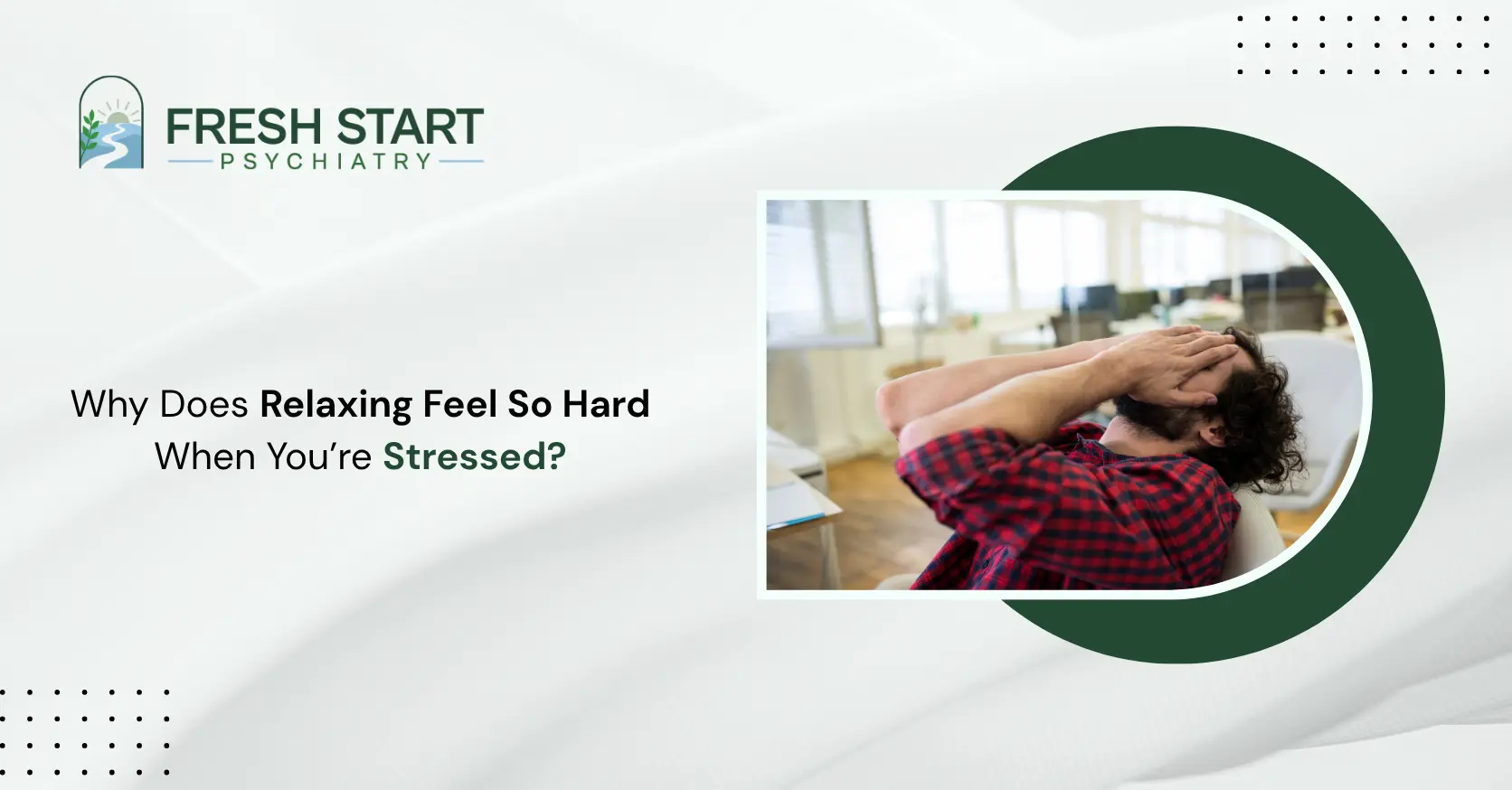
Relaxing feels hard when you’re stressed because your brain and body are still in “danger mode.” The nervous system stays on high alert, so calm can feel strange or even scary. This is common and not a personal failure. With the right support, your body can learn to feel safe enough to rest truly.
Fresh Start Psychiatry provides a starting point for exploring psychiatric care and mental health support.
What Is the Psychology of Rest?
Many people think rest is just not working. However, the psychology of rest proves that it is so much more.
True rest is a change from constant alertness. It’s about relaxing your mind and your body without remorse or worry.
This transition activity can be thought of as nearly impossible for those who are living with long-term stress.
What Happens in Your Body When You Try to Relax?
When you face stress, your brain flips a switch. It tells your body to get ready to fight, run, or freeze. This is the fight-or-flight response.
- Your heart beats faster
- Your muscles tighten
- Your breathing gets quick
This system is designed to protect you. But it has a problem. It can’t always distinguish between the stressful thought of money, work, or family and a true threat. So, your body stays revved up even when the “danger” is just a full calendar.
When you finally try to sit still, your body does not get the message right away. It may still feel tense or on edge. That’s why it’s difficult to relax.
Why Does Trying to Relax Sometimes Make You More Anxious?
This has a name. People call it stresslaxing or relaxation-induced anxiety. It is when your stress response is activated when you’re trying to deactivate it.
Research indicates that this is not uncommon. Between 17% and 53% of adults have reported feeling more anxious when they try to relax.
Why?
- Your brain may see calm as something unsafe.
- If you are used to being on guard, slowing down can feel strange.
- Your mind may start to race.
- You may worry that you are wasting time or that something bad will happen if you let your guard down.
Why Does Long-Term Stress Make Rest Hard?
A little stress now and then is normal. However, stress that persists for weeks or months can become exhausting.
Your body can remain alert for threats, even if not necessary.
This can make it more difficult to relax over time. It may be difficult for your body to move from stress to rest.
Doctors and scientists call the strain caused by long-term stress allostatic load.
Don’t think that you are weak. It may mean your mind and body have been working too hard for too long.
Good rest, health care and appropriate help can make you feel better.
What Is Hypervigilance and How Does It Block Relaxation?
Hypervigilance is a state of being constantly on guard. Your brain scans for danger even in safe places. It is common in people with anxiety, chronic stress, or a history of trauma.
Because of hypervigilance:
- Letting your guard down can feel risky
- Relaxation may feel like the quiet before something bad happens
- Your body resists it to protect you
How Can You Make Relaxation Feel Safer?
You don’t have to force yourself to relax. In fact, forcing it can backfire. The goal is to help your body feel safe enough to calm down on its own.
Whether or not you ever attempt formal relaxation, these steps can help:
- Try micro-switching. Make fists for 5 seconds, then open your fists. Tense your shoulders, then drop them. Small release teaches your body it is safe to release.
- Take advantage of a permission pause. Set the timer for 2 minutes, and your sole task is to sit and breathe. Remind yourself: “This is allowed.”
- Use long exhales. Exhale for an extended time period while inhaling for a shorter period. This can engage the relaxing controls of your nervous system.
- Rest after working. An increasing amount of stress energy is dissipated by walking.
- Treat yourself with kindness. Be aware of when you are inducing calm. Take your time; it is ok.
- Talk to a professional if it keeps happening. You don’t have to do this all by yourself.
When Should You Ask for Help?
If you notice that relaxation regularly makes you feel worse, or you’re struggling with stress that’s hurting your sleep, temperament, or daily life, book a visit.
Get emergency care right away for:
- Sudden chest pain or pressure
- Sudden weakness, face drooping, or trouble speaking
- Thoughts of harming yourself or others
At Fresh Start Psychiatry, we offer anxiety and stress treatment, psychiatric evaluation and medication management for people dealing with constant anxiety, racing thoughts and difficulty relaxing.
Our provider, Anita Richardson-Sasson, PMHNP-BC, has nearly 20 years of nursing experience and 10 years as a board-certified psychiatric mental health nurse practitioner. She focuses on a warm, collaborative and holistic approach. We offer in-person and virtual visits.
FAQs
Why can I not stop thinking about my worries?
Your brain is making an effort to solve issues to be safe. When you’re stressed, you wind up in a way of thinking about the issues. With the proper treatment and help, this cycle can be broken.
Is it normal to feel tired but not be able to sleep?
Yes, this is common. Even when exhausted, stress chemicals keep your mind attentive. Fresh Start Psychiatry can help you sleep better.
The Bottom Line
When your nervous system is stressed, relaxing is challenging. That is not a personal failure. Simple steps and help can make calm safe again.
Ready to talk it through?
Schedule a visit with Fresh Start Psychiatry.
This article is for education only. It isn’t medical advice, diagnosis, or treatment.

No comment