
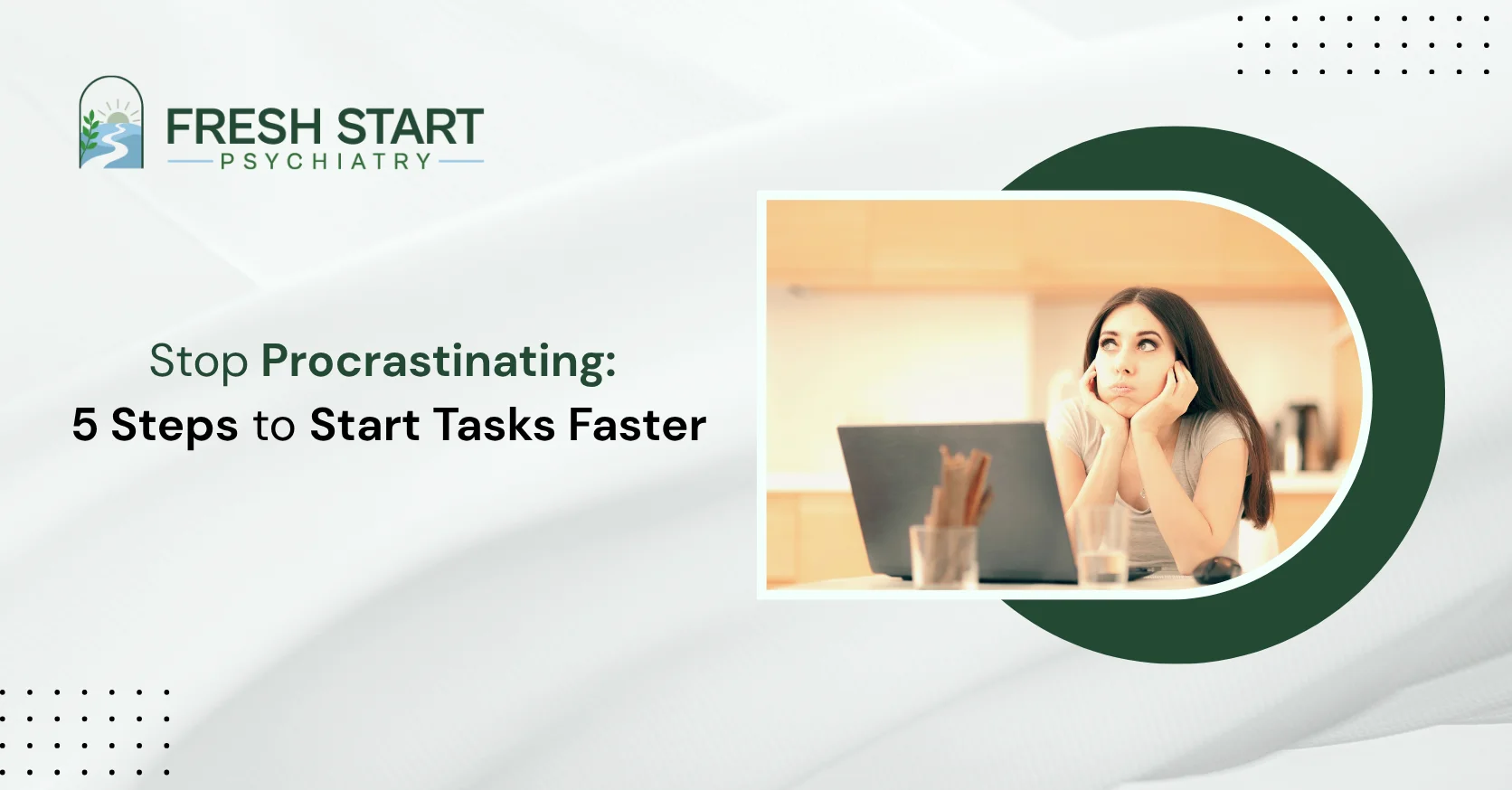
Do you look at a big pile of work and want to run away? You are not alone. Putting things off is called procrastination. Sometimes, we wait until the last second to do our chores. We feel stressed inside. We watch the clock tick and worry.
You have the power to change your daily habits. You can learn to start your tasks quickly. It just takes practice every day.
At Fresh Start Psychiatry, we help adults who struggle with focus, organization and starting tasks. Our ADHD evaluation and treatment services are designed for people who feel stuck.
Below, we will share five simple steps you can try right now. These steps are simple to learn.
Step 1: Make the First Step Tiny
One of the easiest ways to stop procrastinating is to make the starting point very small. You do not need to promise that you will finish everything; you only need to begin.
Do not tell yourself: “I have to finish this report.”
Instead, say: “I will open the document.”
If you need to answer emails, open your inbox. If you need to exercise, put on your shoes. If you need to study, open the book to the correct page. A small action creates movement and once we begin, continuing often feels easier.
Step 2: Use A Timer for Five Minutes
Starting is the hardest part of any job. Sometimes your brain needs a clear finish line. It needs to know that the pain will end. A timer gives your brain that promise.
Set a timer for just five minutes. Tell yourself you will only work for those five short minutes.
This is called the five-minute rule. It works because it lowers the barrier.
Five minutes is a short amount of time. You can do almost anything for five minutes. When the timer starts, jump right into your task. Work hard until the timer rings. When the timer stops, you have permission to stop working.
Step 3: Remove Distractions Before You Begin
Starting a task becomes harder when distractions are within reach.
Before beginning, take a minute to prepare the environment.
- Put your phone away.
- Close unnecessary browser tabs.
- Turn off notifications.
- Keep only the materials needed for the task in front of you.
For adults who struggle with attention, reducing distractions can make a meaningful difference.
You do not always need more willpower. Sometimes you need fewer things competing for your attention.
A simple workspace can make the next action more obvious.
Step 4: Give Yourself a Clear Start Time
“Later” is not a real time. Pick a clear time instead. For example, say, “At 9:00, I will spend ten minutes paying my bills,” and prepare your materials before 9:00 arrives.
You can also connect a new task to something you already do:
- After breakfast, check your calendar.
- After coffee, answer one important email.
- After dinner, prepare for tomorrow.
Simple routines reduce the need to make a new, exhausting decision each day.
Step 5: Give Yourself a Nice Reward Right Away
Your brain loves to get treats. When you do something good, you should give yourself a fun prize to help your brain feel happy about doing hard work.
Always pick your special reward before you start your task:
- “If I read three pages, I can eat one piece of chocolate.”
- “If I answer these emails, I can go outside for a walk.”
Make sure the hard work always comes first and the fun reward comes second. This simple trick makes your brain excited to get started and will make you want to do the work again tomorrow.
When Procrastination Is More Than a Bad Habit
These five steps can help anyone. But for some people, procrastination is not just a bad habit. It is a symptom. It is a sign that your brain works differently.
If you have ADHD, starting tasks is not about willpower. It is about how your brain manages focus, motivation and time. People with high impulsivity often put things off until later. They might face executive functioning challenges in daily life. If this sounds like you, ask a doctor for help.
At Fresh Start Psychiatry, we offer professional ADHD evaluation & treatment. We provide comprehensive assessments for adults experiencing difficulty with focus, organization, procrastination, impulsivity, time management and executive functioning.
A professional review can help determine whether ADHD is linked to your difficulty starting tasks, and can uncover other issues affecting your focus, motivation, sleep, mood, or daily life.
We also provide medication management, anxiety and stress treatment, depression treatment and PTSD and trauma-related support. Our approach is patient-centered and focused on practical support for real-life challenges.
Time to Take Your First Step
You do not have to live your life stuck. You do not have to spend every day fighting your own brain. You can learn to start tasks faster. You can learn to stop procrastinating. You can find a fresh start.
It begins with one small step. Make the task tiny. Set a timer. Change your space. Ask a friend to sit with you. Eat the frog. And if you need more help, reach out to us. We are here to help you take that first step toward a healthier, more productive you. We offer virtual and in-person appointments.
FAQs
Can I fix my procrastination problem?
Yes, you can absolutely fix it. Using simple tools like timers, small steps and fun rewards can make a huge difference. Professional treatment can also teach you new ways to manage your time and your mind.
Is procrastination a sign of ADHD?
Not always. Everyone puts things off sometimes. But frequent problems with focus, planning, organization and time management can be linked to ADHD.





No comment